Learn by building
Explore biomedical sensors and acquisition, signal conditioning, circuit simulation, PCB design and embedded boards through guided demonstrations and practical activities.
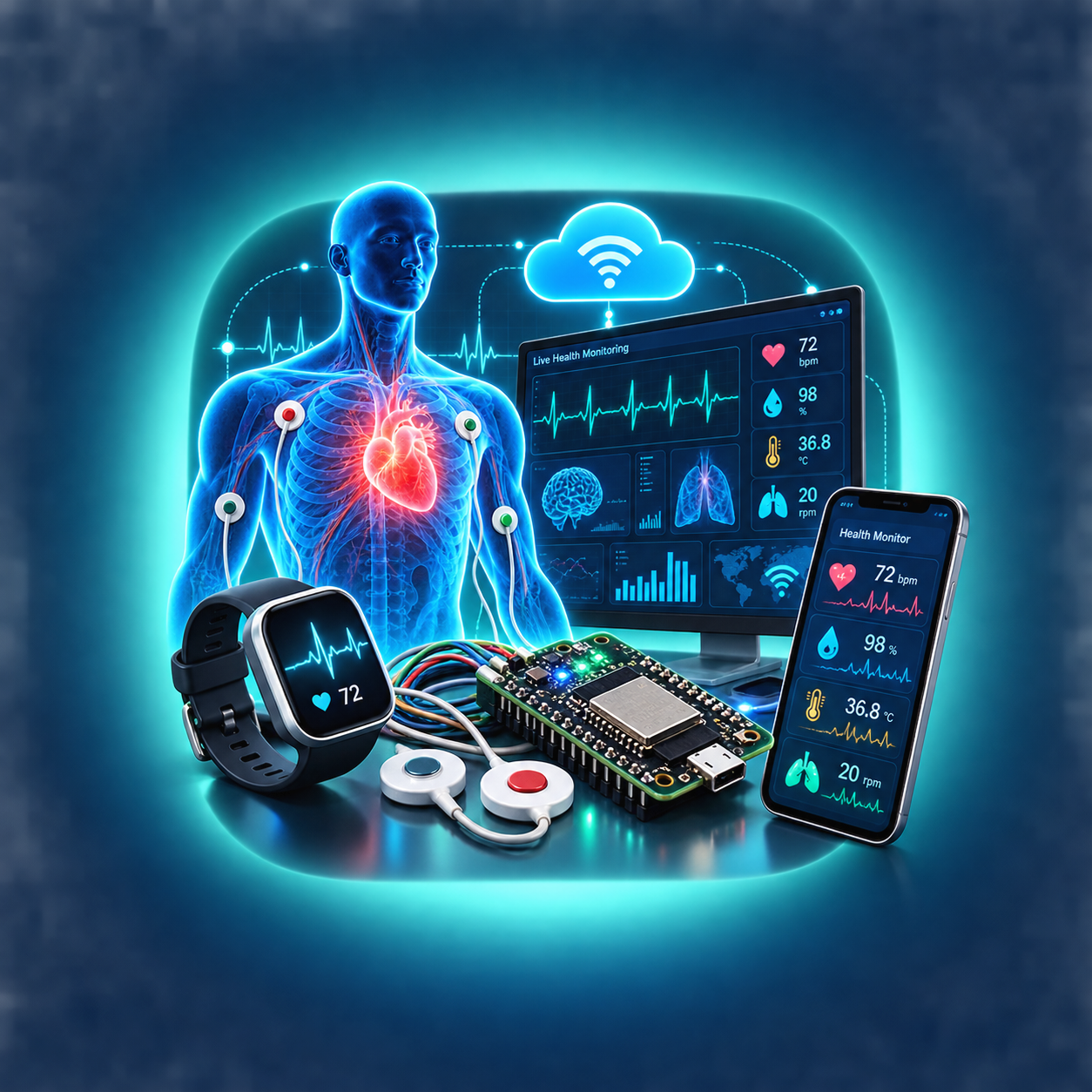
A focused Skill Development Programme connecting biomedical signals, sensors, embedded systems, PCB design and IoT dashboards to real-world healthcare innovation.
Designed as a compact, practical learning experience, the programme moves from the fundamentals of biomedical signals to sensor interfacing, cloud logging and a demonstrable smart-health prototype.
Explore biomedical sensors and acquisition, signal conditioning, circuit simulation, PCB design and embedded boards through guided demonstrations and practical activities.
Collect sensor data, visualise it with MATLAB or Python, send readings to cloud platforms and explore dashboards, remote monitoring and basic alerts.
All sessions run from 2:00 PM to 5:00 PM (17 Nov – 21 Nov 2026). Session faculty allocations are based on the updated programme plan.
Day 1 · Foundations and acquisition
Day 2 · Electrodes, amplifiers and filters
Day 3 · Schematic to fabrication files
Day 4 · ESP32, Firebase & Google Sheets
Day 5 · Integration, evaluation and celebration
Access and download complete circuit schematics, Gerber PCB archives, Arduino and ESP32 firmware, Python telemetry bridges, and companion Android applications for the SDP laboratory sessions.
Complete multi-lead biosignal acquisition hardware package for ECG, EMG, and EEG. Includes production Gerber archives, verified component Bill of Materials (BOM), and circuit schematics.
Official Android companion app for SDP students. Enables mobile dashboard access, quick schedule viewing, lab documentation offline reading, and sensor telemetry streaming.
Direct WiFi telemetry pipeline pushing calibrated EEG voltage frames from ESP32 into Google Firebase Realtime Database for instantaneous low-latency live web charting.
Embedded digital signal processing executing on-chip Fast Fourier Transform (FFT) algorithms on raw EEG data to decompose rhythms into Delta (0.5-4Hz), Theta (4-8Hz), Alpha (8-13Hz), and Beta bands.
Faculty names are shown as listed in the previous SDP plan. Final session allocations may be updated by the organisers.
Smart healthcare, biomedical signals and biosignal fundamentals

Signal acquisition, instrumentation, PCB, embedded systems and IoT integration

Signal conditioning, IoT and hands-on demonstrations

Biomedical sensors and electrodes

IoT applications in smart healthcare
Practical guidance, project evaluation and programme coordination
By the end of the SDP, participants will have followed a practical workflow from signal acquisition to a connected monitoring concept.
Identify common biomedical signals and learn the basics of acquisition, artifacts, electrodes and signal conditioning.
Explore PCB workflows, embedded boards, sensor interfacing and common communication protocols.
Stream, log and visualise sensor data using software and cloud dashboards, then present a prototype concept.
17 November – 21 November 2026 · Daily from 2:00 PM to 5:00 PM